The Most Important Points at a Glance:
- IT cost optimization starts with transparency: anyone who does not know which assets, licenses, and contracts are running is optimizing blindly - instead of targeting the right areas.
- The three most effective levers are license cleanup, automated IT inventory, and structured hardware lifecycle management - all three require up-to-date inventory data.
- Automation does not just save direct costs; it also relieves IT teams of routine tasks - and creates capacity for projects that truly matter.
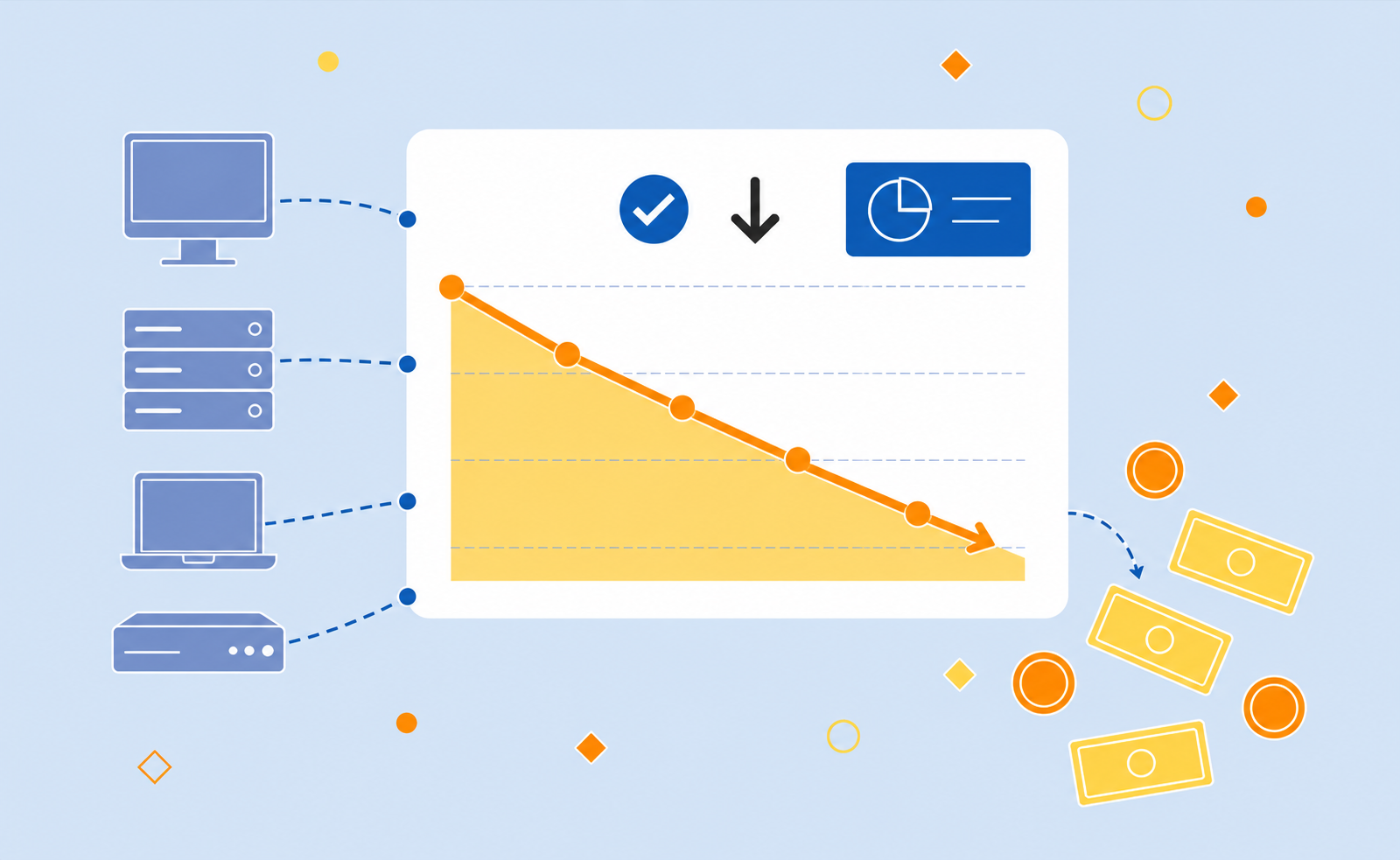
IT cost optimization is easier said than done - especially when it is unclear where the money is actually going. Many IT managers know their total expenditure, but not its breakdown at asset level. That is the real problem: without reliable inventory data, IT cost optimization is guesswork.
This article shows which measures actually work in practice - and why transparency about your own IT landscape is a prerequisite for every single one of them.
What Really Drives IT Costs
IT expenditure can be divided into four main blocks: hardware (procurement, maintenance, disposal), software and licenses, IT personnel, and external services and maintenance contracts. In mid-sized companies, industry observers typically put IT spending at between 2 and 6 percent of revenue - depending on the degree of digitalization and the sector.
[HTML-EMBED: In-text graphic - see embed section]
The problem: all four blocks grow unnoticed if they are not actively monitored. Updates arrive, new devices are procured, old contracts keep running. Software gets subscribed to and then forgotten. Hardware outlives its economic lifecycle - but without an inventory, nobody knows which devices are affected.
There is also a frequently underestimated cost driver: shadow IT. Cloud services that departments adopt without the IT team's knowledge generate duplicate license costs, security risks, and an incomplete picture of spending. Anyone who has not fully mapped their IT landscape does not know what they are really paying for.
Optimizing IT Costs Through Transparency: Why This Is the Foundation
The most common reaction to cost pressure is a budget freeze or blanket cuts. What is saved in the short term often costs more in the long run: overloaded IT teams, more frequent outages, delayed projects.
The more sustainable approach starts with a complete inventory. IT asset discovery is not a bureaucratic exercise - it is the foundation for making targeted decisions rather than across-the-board cuts.
In concrete terms, this means:
- Capturing all assets: What hardware is in use, how old is it, and when does the warranty expire?
- Cross-checking all software licenses: Which licenses are actively licensed, and which are actually being used?
- Reviewing all running contracts: Maintenance agreements, cloud subscriptions, external services - are all of them still delivering value?
Doing this manually in Excel is possible - until the first audit or the first staff change. Automated tools like Docusnap read data agentlessly from the network and keep it current, without IT staff having to capture individual devices by hand.
Concrete Measures for IT Cost Optimization
1. License Management: Identify and Clean Up Unused Licenses
Many companies quietly pay for unused software licenses. Vendors such as Microsoft, Adobe, or SAP do not automatically flag when a license is sitting idle. Regular license audits show which software products are actively used and which can be cancelled.
Practical example: A company with 200 workstations and ten unused Microsoft 365 E3 licenses saves around 3,600 euros per year at approximately 30 euros per license per month - with no loss of quality. (Editorial note: adjust currency for non-EU markets.)
2. Hardware Lifecycle Management Instead of Reactive Replacement
Older hardware frequently generates hidden costs: higher energy consumption, more failures, longer response times, and increased support effort. Organizations that manage hardware cycles proactively - rather than reacting only when devices fail - can plan budgets more predictably and avoid costly emergency procurement.
The prerequisite: an up-to-date overview of all devices with purchase date, warranty expiry, and utilization. What is rarely achievable in Excel is delivered at the push of a button by automated hardware inventory.
3. Automating Time-Consuming IT Tasks
IT departments spend considerable time on tasks that can be automated: asset discovery, report generation, network documentation, compliance evidence. This time is missing from projects that actually contribute to the business.
Automation does not eliminate a role - it gives existing IT staff their capacity back. A two-person IT team that has automated inventory and documentation can complete audit preparations in hours rather than days.
4. Uncovering and Controlling Shadow IT
Unauthorized cloud services or software in business units not only increase security risk - they also generate costs that do not appear in the IT budget. A complete asset scan reveals what is actually running on the network.
5. Reviewing Maintenance and Service Contracts Regularly
Contracts with external service providers and hardware vendors are often renewed automatically - even when the need has disappeared. An annual review of all running contracts against actual requirements uncovers significant savings potential in many IT departments.
What IT Managers Often Underestimate
IT cost optimization often fails not because of a lack of willingness, but because of a lack of visibility. Three points that are regularly underestimated in practice:
Time costs are money costs. Every hour an IT staff member spends on manual asset capture is an hour missing elsewhere. These opportunity costs appear in no invoice - but they are real.
IT documentation is an argument in front of management. Anyone who can show the CFO which assets exist, which licenses are running, and where savings are possible has a factual conversation rather than an emotional one. Without data, IT remains a black box - and black boxes get cut across the board.
Optimizing IT costs does not automatically mean cutting IT costs. Organizations that take a targeted approach - with up-to-date inventory data as their foundation - achieve lasting results, rather than saving in the short term and spending more in the long run.
Next Steps
Anyone who wants to optimize IT costs sustainably first needs a complete overview of their own IT landscape. Docusnap inventories your entire environment agentlessly - and provides the data foundation for all further measures. Try Docusnap free for 30 days.
FAQs
Do you know how much your IT costs?
Many IT departments know their expenses at the departmental level, but not at the asset level. Docusnap discovers your entire IT landscape, agentless and automatically. This allows you to see at a glance where licenses are unused, hardware is past its prime, or contracts are no longer needed.
Try it now