Key takeaways:
- An information security policy is the top-level governing document for information security, approved by senior management. It sets out the priority, objectives, and scope of security - deliberately on just a few pages.
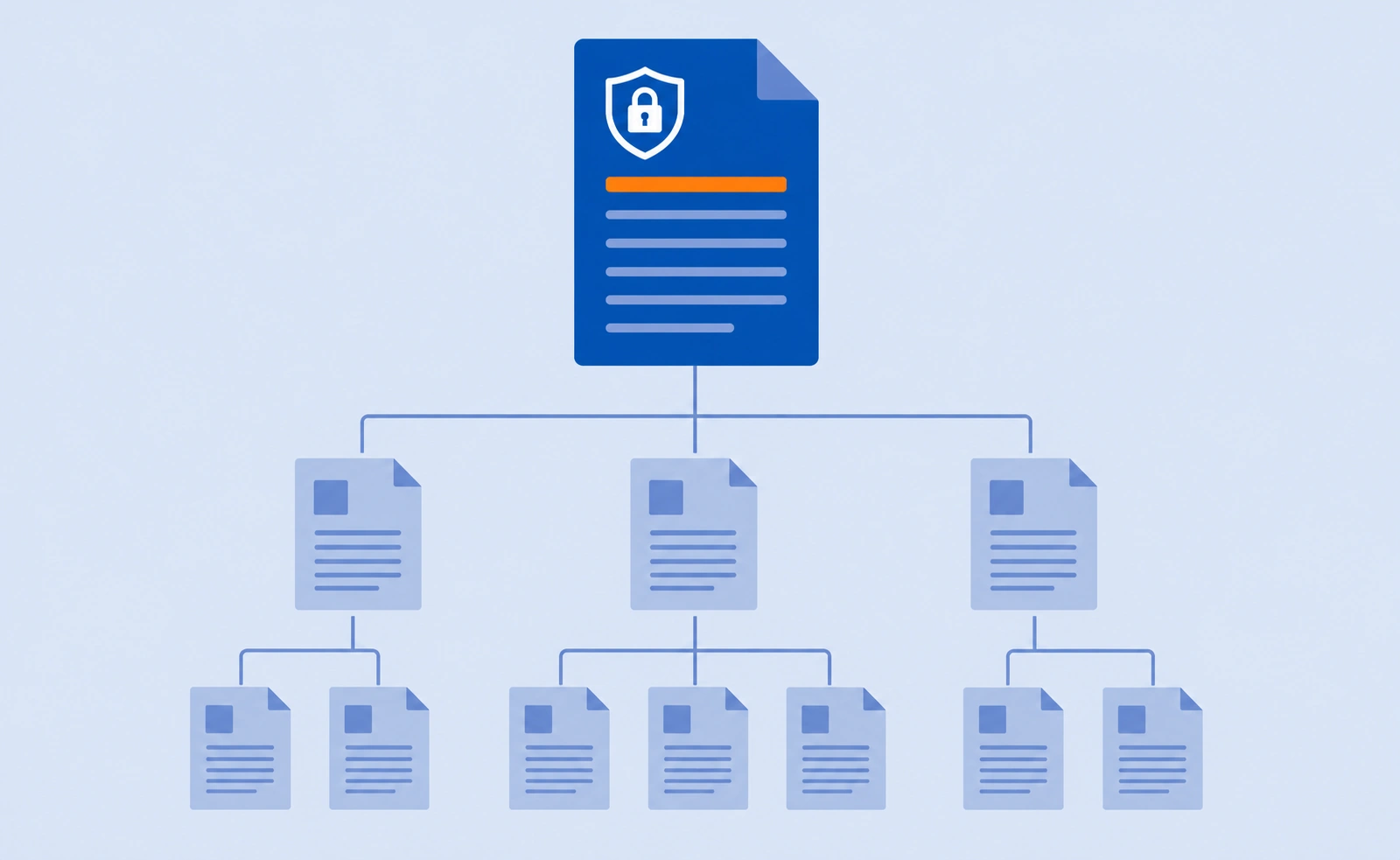
- It sits at the top of a document hierarchy. The concrete rules follow one level down in the security standard; the technical implementation in the security procedure.
- "Information security policy" and "IT security policy" are often used for the same idea, but the broader term covers all information assets, not only IT. Templates from standards bodies and the public sector help with the structure - but they do not replace adapting the policy to your own organization.
Policy, standard, procedure: three terms that get mixed up constantly in practice. An information security policy is the top-level governing document for information security. Senior management approves it, it applies to the entire organization, and it describes the why and the what - not the how. In a few pages, it captures how much weight information security carries, which objectives are pursued, and who the rules apply to. The concrete requirements come one level down. This very distinction decides whether your document convinces an auditor or fails as a non-binding statement of intent.
What is an information security policy?
An information security policy is an organization's written statement of principle on information security. It defines the framework within which all further security measures take place. The term sits at the heart of every information security management system (ISMS): the international standard ISO/IEC 27001 knows it as the "information security policy" that top management approves and that anchors the whole system.
A word on terminology. "Information security policy" and "IT security policy" are often used interchangeably, but they are not quite the same. The broader term is "information security policy", because it covers more than IT: it includes every information asset - paper files or the knowledge in employees' heads just as much as servers and applications. "IT security policy" narrows the focus to technology. In day-to-day use, you will see both, and many organizations treat them as synonyms.
What matters is the character of the document. A policy is overarching and valid for the long term. It deliberately keeps its distance from detailed rules that change often. How long a password has to be, or which cloud services are allowed, does not belong in the policy. Those decisions belong in subordinate documents. The policy itself stays stable - often for years.
In the logic of common standards, the policy comes first. ISO/IEC 27001 treats it as the document that top management approves before analysis, controls, and evidence follow; national frameworks such as the German BSI IT-Grundschutz describe it the same way - as the first step in building an ISMS. The order is always the same: first the statement of principle, then analysis, measures, and proof. Whoever starts with technology and adds the policy afterwards reverses the logic - and finds that out, at the latest, when an auditor asks about the scope.
Why an information security policy is indispensable
Without a policy, the foundation is missing. You can pour any amount of budget into firewalls and endpoint protection - if no one has formally established what needs protecting and who is responsible, security stays a matter of chance.
An effective policy delivers three things that technology alone cannot:
- Commitment: Information security becomes a documented obligation - from the management board to the working student.
- Orientation: In normal operations and in a crisis, everyone knows which principles apply and who decides.
- Traceability: During audits, certifications, and in the event of a claim, the policy proves that the organization takes its due diligence seriously.
Then there is regulatory pressure. The EU's NIS2 Directive (Directive (EU) 2022/2555) obliges organizations across 18 critical and important sectors throughout the EU to put documented risk-management measures in place - measures that are barely provable without a security policy. Member States transpose the directive into national law, with their own deadlines and penalties. International standards such as ISO/IEC 27001 point in the same direction: they treat an approved security policy as the starting point of every ISMS. Whoever has nothing to show here does not fail on the technology, but on the missing foundation.
Policy, standard and procedure: the document hierarchy
This is where the most common confusion sits - and the point at which most guides turn vague. Information security is organized in a hierarchy that you can picture as a pyramid. Each level makes the one above it concrete.
At the top sits the policy. It is general, strategic, and addressed to everyone. One level down come standards, which set binding rules for individual topics. A further level down sit procedures and operating instructions with the technical and organizational implementation. At the very bottom lies the ongoing documentation of the ISMS as it is actually lived.
The rule of thumb: the policy says why security matters. The binding rules one level down - covered in our guide to the IT security guideline - say which rules apply. The security procedure says how the measures are implemented technically. Whoever presses everything into a single document loses exactly this clarity - and management ends up carrying a 40-page rulebook it will never read.
What belongs in an information security policy
A policy does not have to be long, but it does have to be complete. These building blocks should be in it:
- The role of information security: Why the topic matters to the organization, and which assets are protected in concrete terms.
- Link to business objectives: How information security safeguards the organization's actual work instead of obstructing it.
- Security objectives: The three classic protection goals - confidentiality, integrity, and availability - applied to your own context.
- Scope: Which sites, systems, people, and data the policy applies to.
- Management responsibility: The visible commitment of senior management. Without that commitment, the policy is worthless.
- Security organization: Who takes on the role of information security officer (ISO) and how the security team is set up.
- Reference to the detail level: The note that standards and procedures give the policy its concrete shape.
- Commitment to continuous improvement: Information security is a process, not a one-off project.
The decisive point is the commitment of leadership. A policy that is not visibly backed from the very top fizzles out. The moment senior management claims exceptions for itself, no one else follows the rules either.
Defining the scope correctly
The scope is the part of the policy that triggers the most discussion - and the part auditors check first. It answers a deceptively simple question: what does the document apply to? Sites, subsidiaries, employee groups, IT systems, outsourced services - all of that can sit inside or outside the scope.
Two approaches are common. Either the policy applies to the entire organization, or it is deliberately limited to a defined area, such as a single site or a critical application landscape. Both are legitimate. What matters is that the boundary is clear and traceable and leaves no grey zones.
This is where it becomes obvious why a policy rarely succeeds without knowing your own IT landscape. Whoever defines the scope as "all production systems" but holds no complete list of those systems describes an aspiration, not a fact. The risk assessment that follows builds directly on this scope - and inherits every gap that arises here.
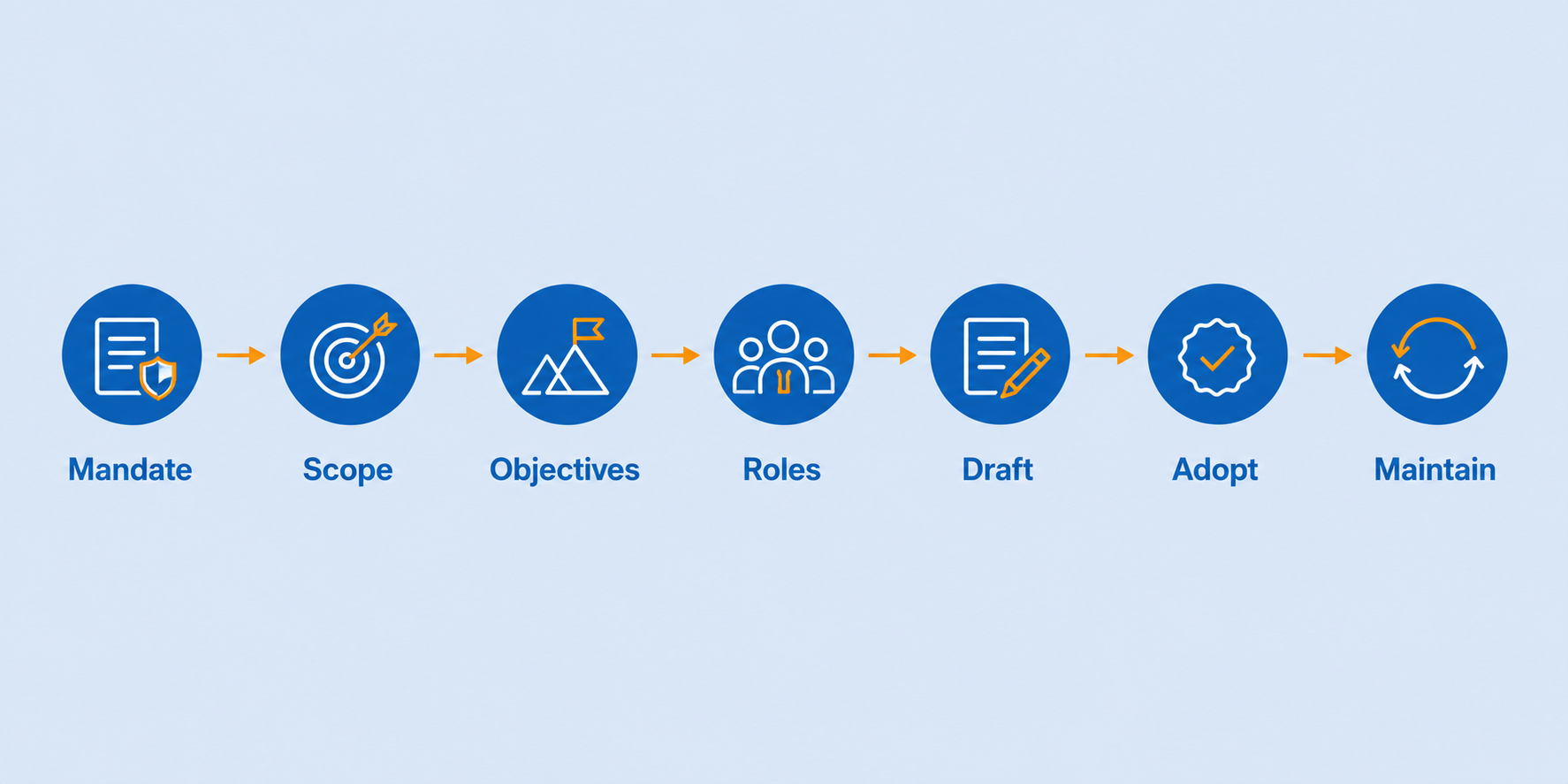
Seven steps to an effective information security policy
A policy is not created at one person's desk. This sequence has proven itself:
- Obtain the leadership mandate. Senior management has to commission the work and approve the result later. Start here, not with the writing.
- Mark out the scope. Clarify which systems, sites, and data are covered. This step requires an up-to-date overview of your IT.
- Set the security objectives. Translate confidentiality, integrity, and availability into statements that fit your organization.
- Name the responsibilities. Determine the information security officer and the security organization. Without clear accountability, the policy stays theory.
- Draft the document. Keep it short. Three to five pages are enough in most organizations.
- Align and adopt. Bring in managers and - where they exist - data protection officers and employee representatives. Then leadership formally puts the policy into force.
- Communicate and maintain. Make the policy accessible to everyone and review it regularly, at least once a year.
Realistically, the initial draft in a mid-sized company takes a few weeks - the larger part of which goes into alignment, not writing.
Common mistakes - and how to avoid them
The same stumbling blocks turn up again and again in practice:
- Copy-paste from a template. Someone else's policy rarely fits your own organization. Templates are a starting point, not a finished result.
- Too much detail. Once password lengths and tool names are in the policy, it is out of date after the next tool change.
- Leadership is not behind it. A policy without a visible commitment from senior management gets ignored.
- Written once, never updated. The three-page document from 2019 holds up to no audit.
- Scope without a data foundation. Here lies the blind spot almost no one names: you cannot define a clean scope if you do not know which systems, applications, and permissions exist in the first place.
The last point deserves particular attention. A policy names the "assets to protect". Whoever knows their IT landscape only in patches describes a scope that diverges from reality. An up-to-date IT documentation is therefore not busywork, but the prerequisite for a policy that holds up.
Using templates and examples the right way
Search for an "information security policy template" and you quickly find ready-made documents - many of them good. Standards bodies, industry associations, and public-sector authorities publish sample texts and structures that are freely available.
These templates show how a policy is structured and which formulations have proven themselves. But they do not replace your own work. A policy is always a mirror of the organization: its size, its industry, its risks. Adopt the structure, but fill it with your own objectives, responsibilities, and values. A copied example is exposed at the latest during an audit, when the described processes do not match the practice that is actually lived.
A sensible sequence: take a template as scaffolding, delete everything that does not apply, and add what sets your organization apart. The result is shorter and more honest than the template - and that is exactly why it is more effective.
Information security policy in the public sector
Public administration carries particular weight here. Across the EU, public administration is one of the essential sectors covered by the NIS2 Directive, and many governments make a security policy binding for their authorities and recommend it to subordinate bodies such as municipalities. Building on this, public-sector organizations frequently publish their own model policies.
These sample documents are instructive for companies too, because they structure the contents of a policy very cleanly. The build always follows the same logic: role, objectives, scope, responsibilities, reference to the detail level. Whoever looks for a public-sector template usually finds a workable skeleton - regardless of country.
The data foundation of your policy
A policy is only as robust as the picture you have of your IT. Scope, assets to protect, critical systems - all of that requires the inventory to be known and current.
This is exactly where Docusnap comes in. The software inventories Windows, Linux, and cloud environments agentlessly and keeps the inventory current automatically. Permissions can be analyzed, dependencies visualized, and reports for audits generated at the push of a button. You do not get the policy itself this way - that remains a leadership task. But you get the data foundation on which scope and evidence can stand in the first place.
Next steps
An effective information security policy starts with a leadership commitment and a clear scope. If your next move is to work out the concrete rules, our article on the IT security guideline is the right place to continue. And if you want to build the data foundation for the scope, a short live demo shows how Docusnap makes your own IT visible.
FAQs
A policy is only as good as its data
An information security policy defines the scope and the assets to protect. That assumes you know which systems, data, and permissions exist. Docusnap inventories your environment agentlessly and keeps the overview current - the data foundation for a policy that holds up.
Schedule a Live Demo