Key Takeaways
- An IT risk analysis is a structured process that identifies potential threats to IT systems, assesses them by likelihood and impact, and prioritises them – forming the foundation for all subsequent security measures.
- Qualitative and quantitative methods each have distinct strengths: qualitative analysis delivers fast prioritisation based on expert judgement; the quantitative approach assigns monetary values to risks. In practice, both approaches complement each other.
- The quality of a risk analysis depends directly on the completeness of IT asset discovery: anyone who does not have a thorough picture of their infrastructure is assessing risks against an IT landscape that no longer exists.
Three weeks until the next audit. Your manager asks which IT risks the organisation is actually carrying – and you realise you cannot give a clean answer. Not because you do not know your infrastructure, but because no one has ever systematically mapped what sits where, what the dependencies are, and what happens when a critical system goes down.
IT professionals know this feeling well. IT security was long a matter of gut instinct: as long as nothing is on fire, everything is fine. Strategically, that principle has been untenable for years – and from a regulatory standpoint, it now is as well.
What an IT risk analysis actually delivers, which methods hold up in practice, and what to watch out for when getting started – read on.
What Is an IT Risk Analysis – and What Does It Actually Deliver?
An IT risk analysis is a structured procedure for identifying, assessing and prioritising potential threats to information systems and IT infrastructure. It captures technical risks as well as organisational vulnerabilities, human error factors and legal requirements.
That sounds like textbook definitions. In practice, it means this: you systematically analyse which of your systems would be affected by which type of incident – and to what degree – and use that to determine where investment in protective measures is economically justified and where it is not. Risk is assessed using the formula likelihood × impact. The result is not a guarantee against attacks, but a reliable basis for decision-making.
One important point: the analysis is not a one-off project. It is a process that must be repeated regularly – after every significant infrastructure change, after security incidents, and at least annually as part of a management review.
Why Is IT Risk Analysis Non-Negotiable Today?
Three developments have elevated risk analysis from a nice-to-have to a core responsibility.
The threat landscape has changed structurally. Ransomware, supply chain attacks and undocumented shadow IT in grown infrastructures are no longer edge-case risks. Without a complete overview of IT assets, these risks cannot be systematically captured – or controlled.
IT infrastructures have grown more complex. Hybrid environments spanning on-premises, cloud and externally managed services can no longer be tracked in a spreadsheet. The number of potential attack surfaces is growing faster than most IT teams' capacity to monitor them manually.
And: regulatory frameworks such as ISO 27001 and the BSI IT-Grundschutz require a systematic risk assessment as a mandatory component of an information security management system (ISMS) – not as an optional add-on, but as its methodological core.
Qualitative or Quantitative: Which Method Suits Your Organisation?
Most IT professionals approaching a structured risk analysis for the first time ask the wrong question: not "which method is correct?" but "what can I realistically start today?". The answer depends less on theoretical preferences than on what is practically achievable in your organisation right now.
If you have no historical loss data – and in most mid-sized IT departments, you will not – start qualitatively. That means: a workshop with the relevant IT stakeholders, a list of critical systems, and an honest assessment of each risk on a three-point scale (high/medium/low). The result is subjective, but it is better than no result at all. And it is auditable, as long as the assessment criteria are documented in advance.
The quantitative approach comes into play when you need to justify budget decisions to senior management. When the board asks why the new firewall should cost €80,000, a number helps: the risk being mitigated has a statistically expected annual loss of X euros. This calculation requires likelihood estimates from industry statistics or internal incident data – the method is more demanding, but its output is directly decision-ready.
In practice, most organisations combine both approaches: qualitative for initial prioritisation, quantitative for assessing the highest-priority risks. Recognised standards such as ISO 27005, BSI Standard 200-3 and ISO 31000 each provide different methodological frameworks for this.
How Does an IT Risk Analysis Work Step by Step?
The process follows a clear structure – adapted to the size and complexity of your organisation.
Step 1: Define scope and context.
Before the analysis begins, you need to clarify what is being analysed: individual systems, a single site, the entire infrastructure? Which legal requirements apply? Who is responsible? Even this first step often brings clarity about where accountabilities were previously undefined.
Step 2: Fully capture IT assets.
A risk analysis is only as good as the data it is based on. All relevant components must be documented: servers, applications, networks, access rights, external service providers and interfaces. Relying on outdated spreadsheets means assessing risks against an IT landscape that no longer exists. Agentless inventory tools make this first step possible within hours – and keep the data foundation automatically current.
Step 3: Identify threats.
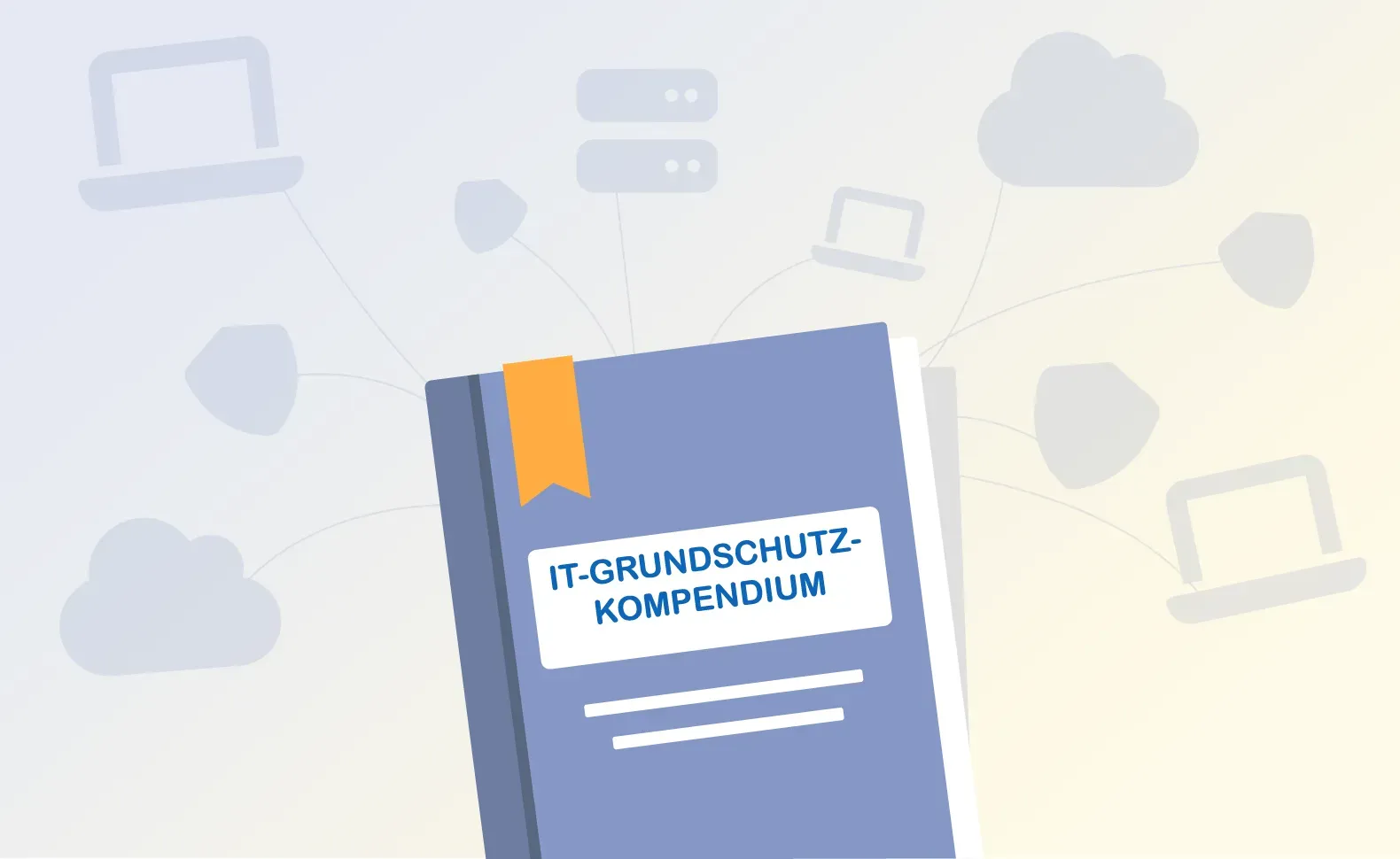
Which threats apply to your assets? The BSI IT-Grundschutz Compendium lists elementary threats – from technical failures and cyberattacks to human error. This list is supplemented by scenario-specific risks arising from your particular infrastructure.
Step 4: Assess risks.
For each identified threat, estimate likelihood and impact. A three-point scale (high/medium/low) is common, documented in a risk register. The result: a risk matrix that shows where action is required.
Step 5: Define measures.
For each prioritised risk, choose a treatment strategy: risk avoidance, risk mitigation, risk transfer (e.g. insurance) or risk acceptance. Each measure receives an owner and a timeline – this is not a recommendation but a requirement under ISO 27001 and established security standards.
Step 6: Monitor and review.
The risk register is updated regularly. New systems, new threats, new regulatory requirements – the IT risk analysis is not a folder gathering dust on a shelf, but a living document.
What Has Changed in IT Risk Analysis in 2025?
The recognised reference frameworks have become more stable. ISO 27005, BSI Standard 200-3 and ISO 31000 are all well-established methods – the choice between them depends less on compliance requirements than on existing infrastructure and the maturity of security management within the organisation.
What has changed: risk analysis has moved beyond the IT function alone – it is increasingly understood as a management responsibility, not merely a technical obligation. This is also reflected in recent regulatory developments. The NIS2 Implementation Act, which has been in effect since December 2025, establishes personal liability for senior management for risk management measures.
Methodologically, little has changed: identification, assessment, treatment, monitoring. What has changed is the rigour with which results must be documented and kept current.
What Common Mistakes Do Organisations Make in IT Risk Analysis?
The most common mistake is not methodological – it is a data problem: incomplete IT asset discovery. When the asset inventory is incomplete, you end up assessing risks against an infrastructure that does not actually exist. Shadow IT – unauthorised cloud VMs, unmanaged SaaS accounts or forgotten legacy servers – carries the highest risk, because complete datasets are being stored outside the organisation's control. What is unknown cannot be protected.
Another frequent mistake: the analysis remains a one-off project – carried out once, documented, and then left untouched until the next audit. Risks rated as "low" two years ago may warrant a very different rating today given new attack vectors.
Finally, many analyses lack the link between technical risks and business processes. A server outage is not an abstract IT risk when that server runs production control and a 48-hour downtime means concrete delivery failures. The Business Impact Analysis (BIA) belongs alongside the risk analysis – not as a separate exercise.
How Does IT Documentation Support Risk Analysis?
The quality of a risk analysis stands or falls with the quality of the underlying data. Anyone who does not fully know their IT landscape cannot fully assess its risks.
This is where structured IT documentation comes in. Automated inventory tools capture all IT assets agentlessly and in real time – servers, applications, user permissions, network dependencies. Tools like Docusnap go beyond basic asset discovery: permission analyses for Active Directory, Exchange and file servers surface access risks, network diagrams reveal critical dependencies, and the integrated risk analysis add-on includes ready-made import dialogues for BSI IT-Grundschutz measures and ISO 27001 controls. The result is a data foundation on which a structured risk analysis can be built – rather than on outdated lists.