The most important thing in brief:
An urgent customer meeting is pending at an international trading company. However, the responsible account manager is on vacation. In order not to jeopardize the deal, a colleague from another department asks for access to the relevant CRM data at short notice. In the absence of a clearly defined approval process, IT Support gives colleagues access — without consulting the specialist department. A few days later, it became known that sensitive price calculations and draft contracts were also available, which led to major internal discussions.
The incident shows how quickly missing or insufficiently regulated access rights can become a security and trust problem. This is exactly where IAM (Identity and Access Management) at:
What is IAM (Identity and Access Management)?
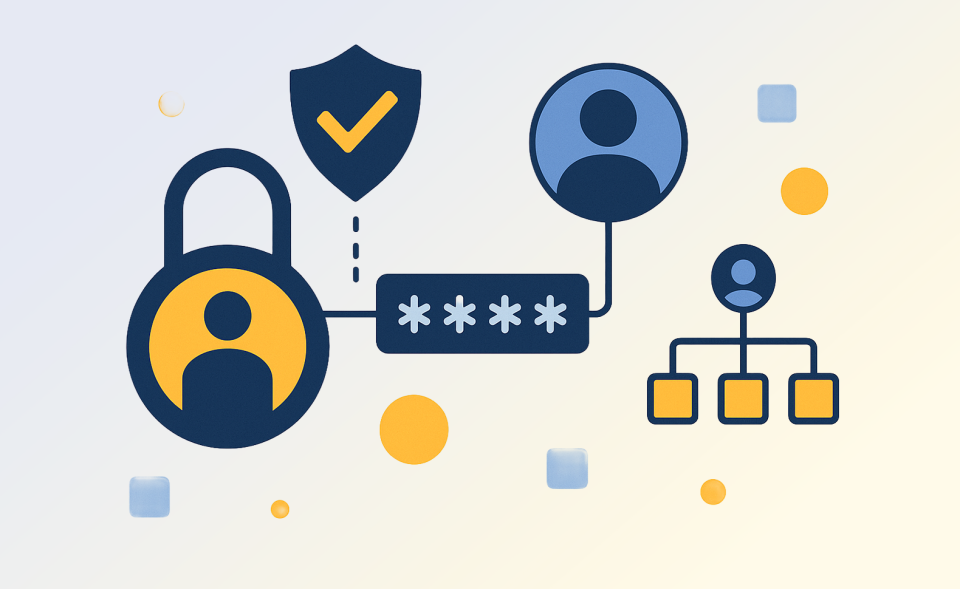
IAM (Identity and Access Management) describes processes and technologies for managing digital identities and users' access rights to IT resources. The aim is to ensure that only authorized persons have access to certain systems and data — and that this is comprehensible and controlled at all times.
Central component of IT security
IAM is not just a technical tool, but a strategic part of every IT security architecture. It combines user administration, authentication, authorization and logging into an integral security concept.
Why is IAM necessary?
1. Protecting sensitive data
With increasing digitization, risks are also increasing. IAM ensures that only authorized persons have access to sensitive information.
2. Regulatory Requirements and Compliance
Laws such as GDPR or industry-specific standards (e.g. ISO 27001, BSI IT basic protection) require complete documentation and control of access to personal or critical data. IAM systems help to comply with these requirements.
3. Increasing efficiency and automation
A structured IAM reduces manual effort when assigning and withdrawing rights and prevents human errors. The benefits are particularly obvious when onboarding, changing roles or offboarding employees.
How is IAM implemented?
1. Identity management
This involves the central management of all digital identities in a company. Each person receives a unique identity with associated attributes (e.g. department, role, location).
2. Access Control (Access Management)
Access is controlled on a role-based basis (RBAC — Role-Based Access Control) or attribute-based (ABAC). This ensures that employees can only see and edit what they need for their work.
3. Authentication and Authorization
Modern IAM systems support multi-factor authentication (MFA), single sign-on (SSO), and delegated permissions to increase both security and user experience.
4. Logging and monitoring
All access events should be documented in a comprehensible manner. This makes it possible to quickly identify and investigate security incidents.
Implementation challenges
- Outdated or incomplete user information
- Lack of transparency with existing authorizations
- Complex rights hierarchies and exemptions
- Lack of integration between different systems
These challenges can only be overcome with a comprehensive, integrated approach. This is where our software comes in Docusnap on.
Docusnap as support for effective IAM
Docusnap As an IT documentation and inventory solution, offers a wide range of functions that ideally complement and support a professional IAM.
1. Transparency through inventory and authorization analysis
With the Permission analysis For Active Directory, Exchange or file servers, Docusnap recognizes who can access which resources. This creates transparency and reveals superfluous or critical rights.
2. Automated documentation
Die IT documentation shows at a glance how users and groups are structured. This visual presentation makes it much easier to evaluate and adapt IAM processes.
3. License overview
With the help of license management It is possible to understand which software is being used with which authorizations. This is a key point for compliance and efficiency.
4. Regular monitoring through reporting
The reporting functions integrated in Docusnap make it possible to create periodic reports on user rights, group memberships and resource access. This allows you to continuously monitor and improve IAM processes.
Conclusion: IAM as the basis of secure IT infrastructures
IAM Identity and Access Management is an integral part of modern IT security strategies. It contributes to compliance with legal requirements, reduces security risks and makes everyday IT life much easier. But IAM can only be implemented efficiently and transparently with the right support, such as Docusnap.