Solutions
Reduce liability risk through demonstrable IT governance
Executives bear personal responsibility for IT security. Docusnap365 documents your IT estate, your risks and your measures so that the evidence is there when it is needed.
Regulatory reality
IT security is a personal responsibility for executives
IT security cannot be fully delegated to an IT department or an external provider. Regulations across the EU hold executives personally accountable for adequate IT risk management. When an incident occurs, the burden falls on the leadership to demonstrate that they acted with due care.
Fiduciary duty and due care
Corporate law in most jurisdictions requires executives to act with reasonable care. A cyber incident without documented protective measures can be considered a breach of duty and may result in personal liability. Documented measures, decisions and controls help demonstrate that due care was exercised.
NIS-2 Directive
The EU NIS-2 Directive requires management bodies of in-scope organizations to approve cybersecurity risk management measures, oversee their implementation and participate in regular cybersecurity training. Member states are transposing these requirements into national law. This responsibility cannot be delegated.
Business judgment rule
The protection of the business judgment rule applies when leadership acts within their discretion on the basis of adequate information and in the interest of the organization. Without documented IT risk management, this basis is harder to establish. Courts assess whether the decision was sufficiently informed and reasonable at the time it was made.
Approach
Documented IT management as the foundation of demonstrable care
Organizations that document their IT estate, risks and measures from the start have the evidence when it is needed. Docusnap365 maps this process onto a single CMDB. Inventory, risk management, vulnerability matching and measure tracking run on one platform. Managed policies sit alongside the related assets. The same data helps reduce security risks and pass audits.
Evidence base in detail
Four building blocks that count in a liability case
Each of these building blocks provides independent evidence. Together they form the documented IT risk management that regulators and courts expect from executive leadership.
IT estate fully documented
Docusnap365 inventories Windows, Linux, cloud and network environments automatically and without agents. More than 25 modules capture hardware, software, permissions and network topology. Scheduled scans keep the data current. Leadership can demonstrate at any time which systems were in operation.
Risks captured and assessed
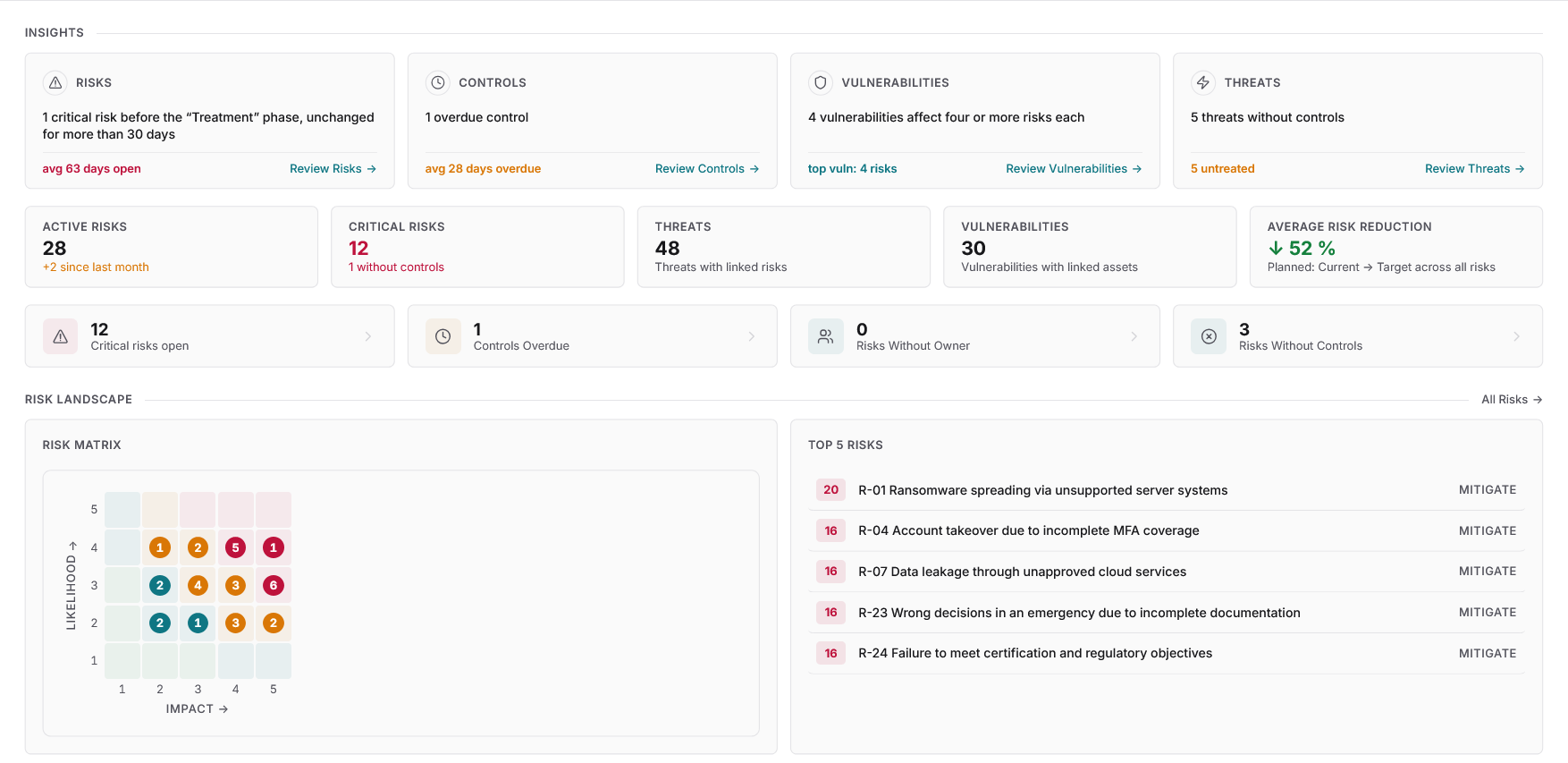
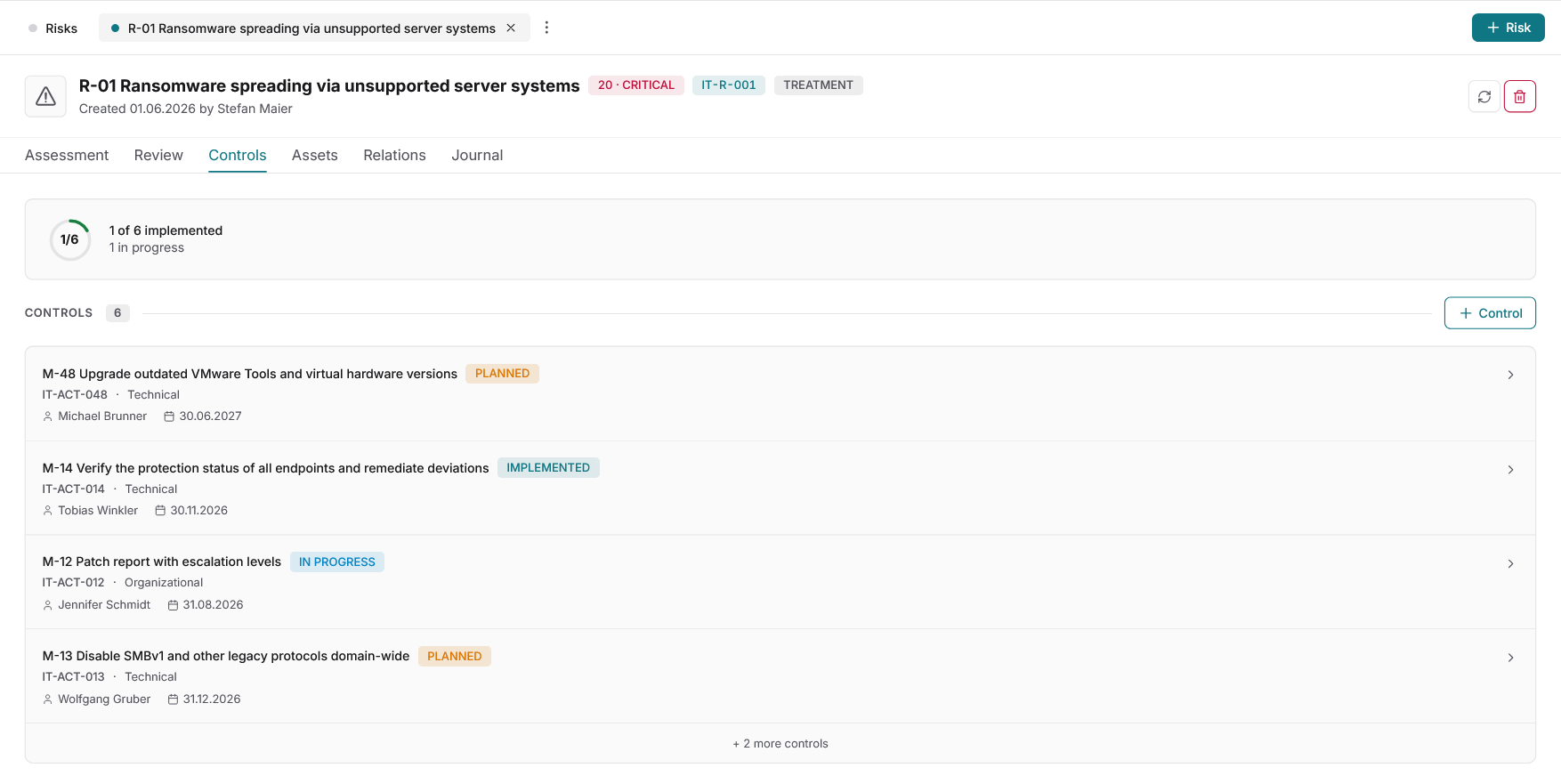
The ISMS module links risks directly to the affected assets in the CMDB. Each risk assessment includes likelihood, impact and the derived measure with an owner and a target date. This produces the risk register that auditors and regulators expect as evidence.
Vulnerabilities tracked to resolution
Docusnap365 automatically matches known CVEs against the inventoried estate. Every vulnerability gets a deadline, an owner and a documented decision. Conscious acceptance is recorded as a decision, not as an omission.
Permissions made transparent
The permissions analysis shows who can access which resources, including nested groups and inherited rights. When an auditor asks about access rights, the answer takes minutes, not days.
Ask your documentation instead of searching through it
The Docusnap365 AI assistant answers from the documented data: estate, risks, measures and permissions, each reflecting the most recent scan.
42 servers at the Munich site, 31 of them virtual on four hosts.
Seven servers run Windows Server 2012 R2, support ended in October 2023.
18 accounts across three groups, four of them with full access.
96 clients and five servers have had no update for more than 30 days.
Four instances on three servers, two of them holding ERP databases.
In three steps
The path to demonstrable IT governance
Capture the IT estate
The Docusnap Enterprise Gateway is installed locally and scans the IT environment without agents, using standard protocols (WMI, SSH, SNMP). Results flow automatically into the cloud CMDB. A complete inventory is available within hours, with no software installed on the target systems.
Assess risks and vulnerabilities
Based on the inventoried estate, risks are captured and assessed. Vulnerability management matches CVEs against the actual installed software. Every assessment, every decision and every measure gets an owner and a target date.
Keep the documentation current
Scheduled scans update the estate automatically. New vulnerabilities are matched against the current state. The task center consolidates all open measures from the CMDB, ISMS and vulnerability management in a single view. The evidence base grows with every scan.
Demonstrate your IT duty of care
In a 30-minute live demo we show you how Docusnap365 builds the evidence base that regulations require of executive leadership.