Features
ISMS software built on real IT data
Docusnap365 connects risk management, action tracking, and permissions analysis with the actual state of your IT infrastructure.
What ISMS software delivers
Information security requires structure, data, and accountability
ISMS software maps the entire information security process in a single platform: from risk identification and assessment through action planning to audit-ready compliance evidence. What matters most is that the software operates on real, automatically collected IT data, so risk assessments reflect the actual state of your infrastructure rather than outdated assumptions.
The challenge
Why information security stalls in day-to-day operations
ISO 27001 describes what an ISMS has to deliver. NIS-2 makes it mandatory. Putting the requirements into practice remains difficult when tools and data live in separate silos.
Risks without a link to your estate
Risk assessments reference abstract descriptions instead of concrete systems. When the infrastructure changes, the assessments stay as they were and the gap between documentation and reality grows with every quarter.
Actions without clear ownership
Tasks get decided, but owners, deadlines, and status end up in separate spreadsheets. Visibility disappears and proving completion to an auditor turns into a reconstruction exercise.
Policies disconnected from operational data
Security policies are drafted in Word documents, stored on a file share, and reviewed when the audit date approaches. Traceable versioning and formal approval are missing and the link to the assets they govern exists only in the author's memory.
How it works
Three steps to a structured ISMS
ISMS
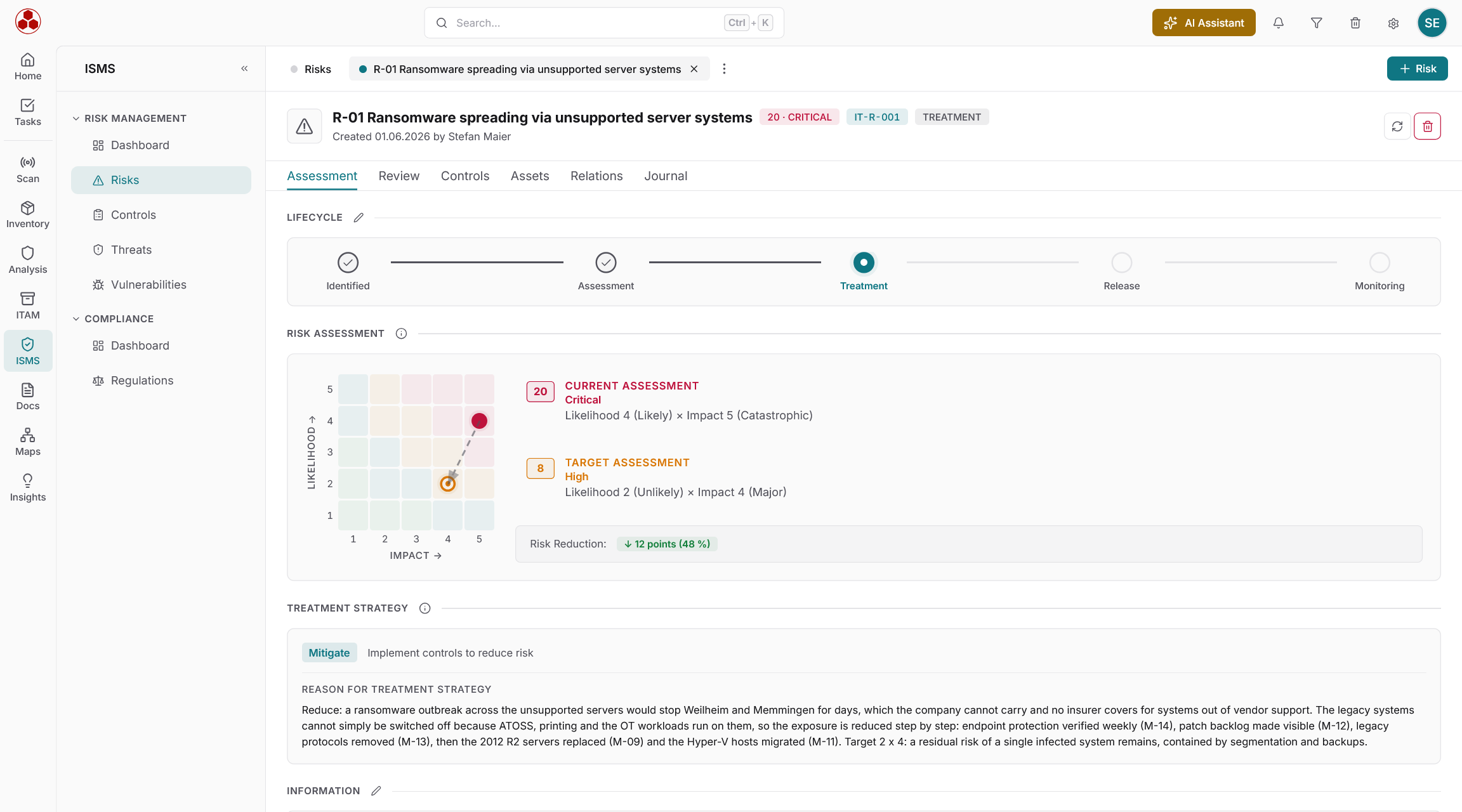
Risk matrix · derived actions
What Docusnap365 covers
ISMS capabilities at a glance
Risk management
Capture, assess, and link risks, vulnerabilities, and threats to real CMDB assets. Risk matrices highlight where action is needed most.
Action tracking
Every action carries an owner, a status, and a due date. From derivation through implementation to effectiveness review, fully documented.
Policies and SmartDocs
Create security policies as controlled documents with a defined approval workflow and version history. Signed PDF export makes policies externally verifiable.
Permissions analysis
Evaluate file, share, and group permissions in the Windows file system. Two directions of analysis: from the user's perspective and from the resource's perspective. Nested groups and inherited rights become visible.
Compliance frameworks
Structural foundation for ISO 27001, NIS-2, and BSI IT-Grundschutz: risk register, action tracking, policies, and evidence in one platform.
AI-powered analysis
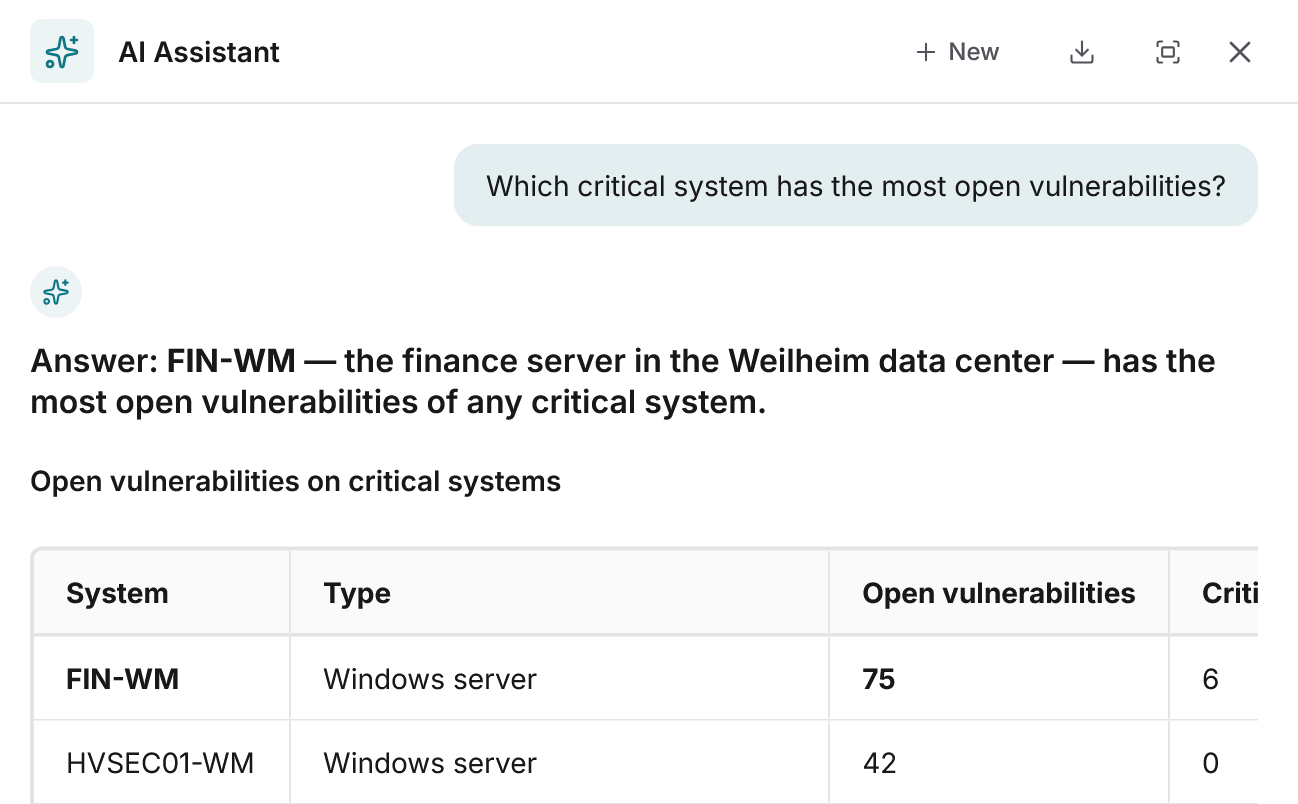
Ask questions about your ISMS posture directly in the AI chat. Answers draw on actual data, from controls and evidence to open actions.
Why Docusnap365
What sets Docusnap365 apart as ISMS software
Many ISMS tools ship their own data model. Assets need separate maintenance, risk assessments require manual reconciliation, and evidence must be gathered from multiple sources. Docusnap365 takes a different approach: one shared data foundation for inventory, documentation, and security.
Risks tied to real assets, straight from the CMDB
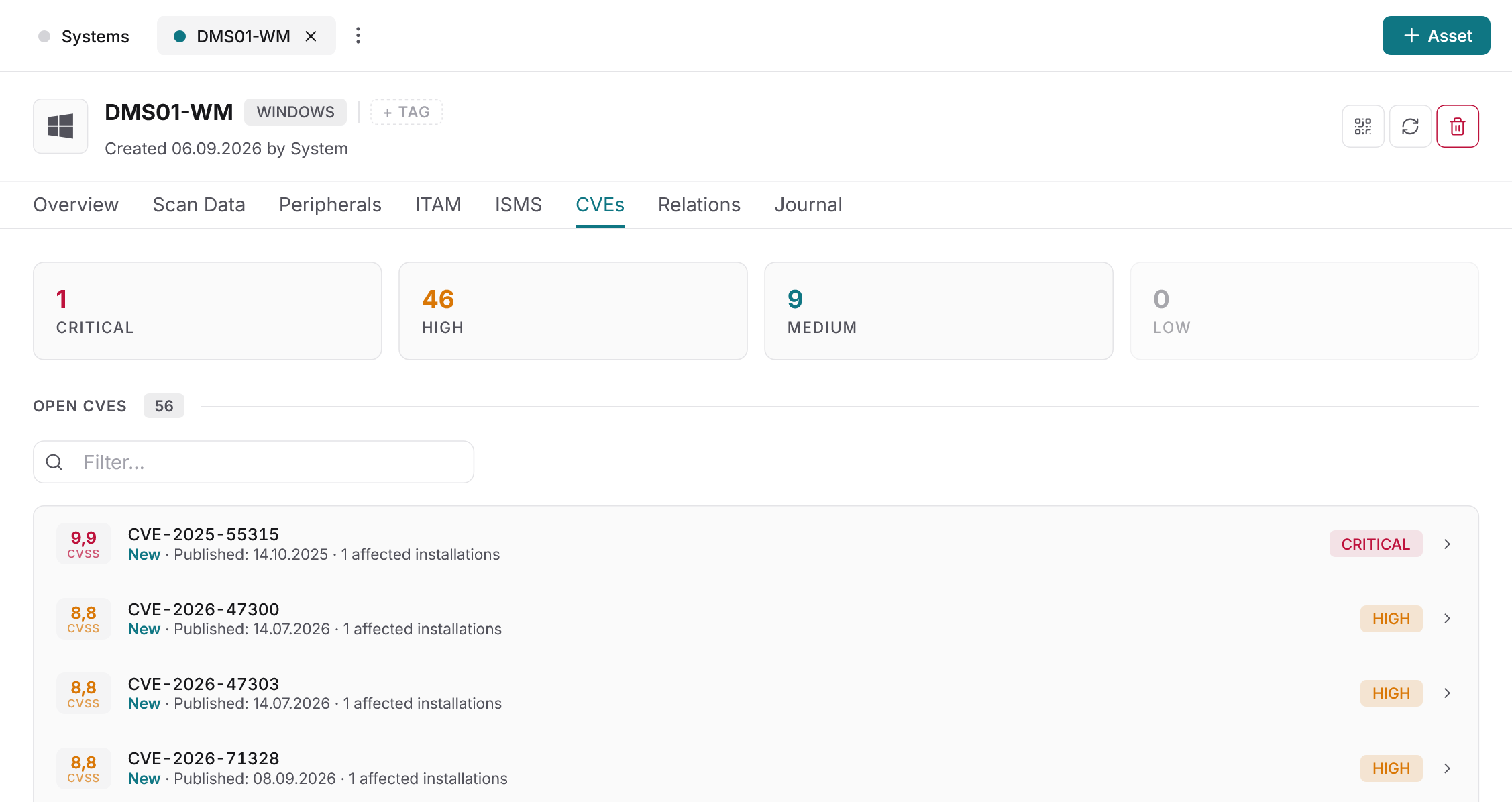
Docusnap365 discovers your IT infrastructure automatically and feeds every result into a central CMDB. The ISMS module operates on exactly that data. Risks map to specific systems, vulnerabilities refer to actually installed software and versions. When your infrastructure changes, the next scan updates the foundation.
Inventory
CMDB · linked risks
Platform
Documentation · inventory · security
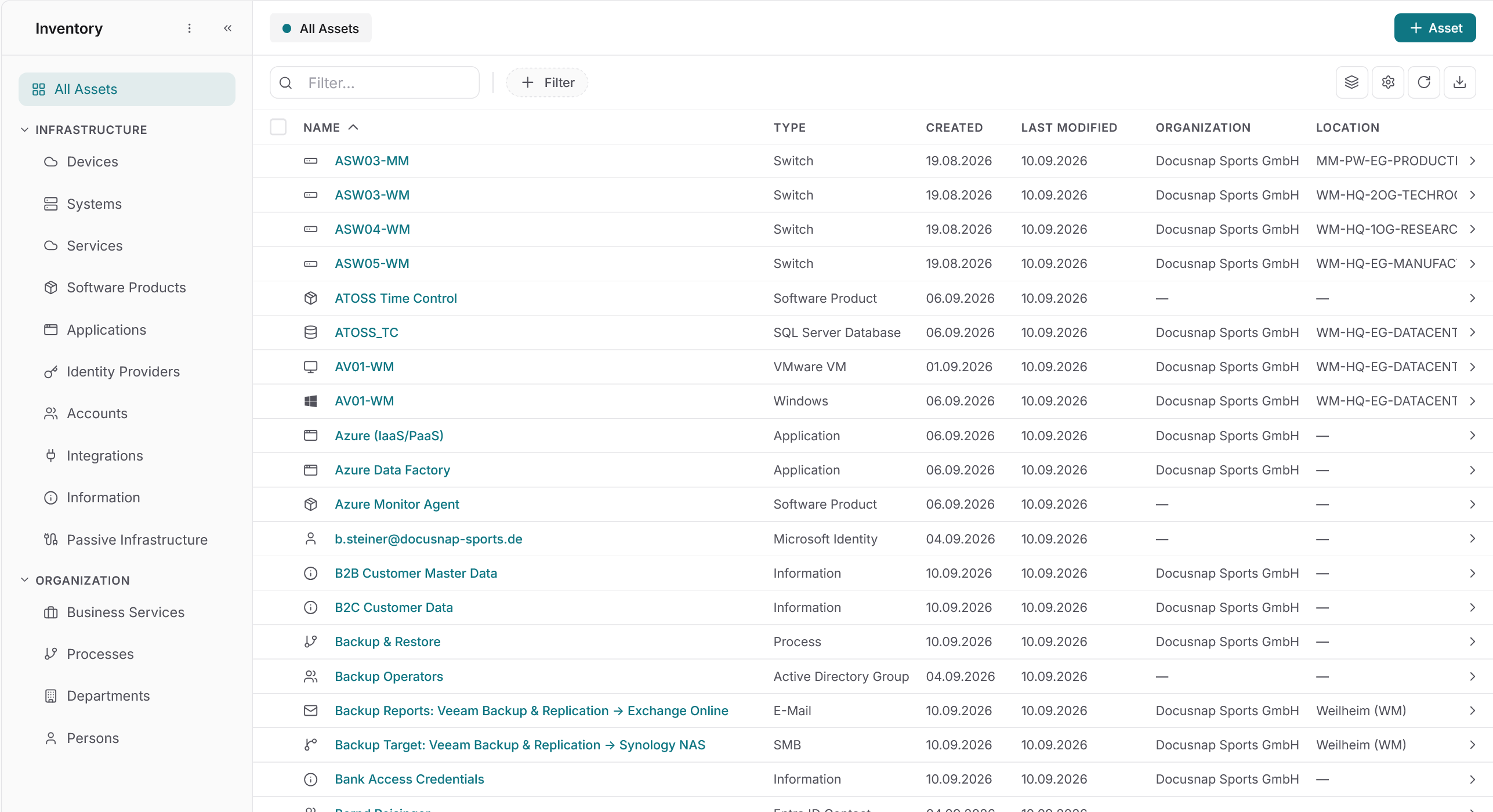
One system for documentation, inventory, and security
IT documentation, discovery, vulnerability management, and ISMS share a single data layer. Risk registers, permissions analysis, and action tracking all reference the same objects. That eliminates reconciliation between separate tools and keeps compliance evidence consistent.
AI model hosted in the EU, with no data sharing
The Docusnap365 AI model runs in the EU. There is no data transfer to external AI providers. GDPR-compliant without a special review, and without sensitive inventory data leaving European infrastructure.
AI chat
Model hosted in the EU
AI-powered analysis
Questions about your ISMS posture, answered from your own data
The AI chat works on your discovered assets, risks, actions, and evidence. The model is hosted in the EU, and there is no data transfer to external AI providers.
42 servers at the Munich site, 31 of them virtual on four hosts.
Seven servers run Windows Server 2012 R2, support ended in October 2023.
18 accounts across three groups, four of them with full access.
96 clients and five servers have had no update for more than 30 days.
Four instances on three servers, two of them holding ERP databases.
The platform behind it
Docusnap365 goes beyond ISMS
The ISMS module is part of an IT management platform that brings discovery, documentation, asset management, and security together on one shared data layer. Four areas that work directly with the ISMS:
Automated discovery
More than 25 modules capture servers, workstations, network devices, cloud services, and virtualization. Agentless, scheduled, straight into the CMDB.
IT documentation
Network diagrams, topologies, and dependencies are generated from discovered data and refreshed with every scan.
Vulnerability management
Automated CVE matching against the discovered estate. Only hits that affect actually installed software, with triage and remediation tracking.
Audit & compliance
Built-in control frameworks for ISO 27001, NIS-2, and DORA. Assess controls, link actions, and keep a running view of completeness.
Frequently asked questions about Docusnap365 ISMS software
Which compliance frameworks does Docusnap365 support?
Docusnap365 provides the structural foundation for ISO 27001, NIS2, DORA, and BSI IT-Grundschutz. That includes the risk register, action tracking, policies, and evidence. Docusnap365 does not certify and does not conduct audits itself. It delivers the evidence base that auditors review.
How are risks linked to IT assets?
Risks are assigned directly to assets that Docusnap365 has automatically discovered from the IT infrastructure. The link runs through the central CMDB. As a result, every risk assessment refers to a specific system with a known configuration and software version.
Do I need a separate inventory for the ISMS?
No. The ISMS module operates on the same CMDB that also feeds discovery and IT documentation. A separate inventory or manual data reconciliation is unnecessary. Changes in the infrastructure are picked up automatically with the next scan.
Is Docusnap365 suitable for mid-sized organizations?
Docusnap365 is used by organizations ranging from mid-market IT service providers to large enterprises, with more than 5,000 companies relying on it. The ISMS module is included in every license and requires no separate setup or additional infrastructure. The cloud-based platform scales with the number of sites and gateways.
How does Docusnap365 handle data privacy for AI features?
The Docusnap365 AI model is hosted in the EU. There is no data transfer to external AI providers such as OpenAI, Google, or Anthropic. The platform is GDPR-compliant without requiring a special review.
Can policies be created and approved directly within the ISMS?
Yes, through the SmartDocs feature. Policies are created as controlled documents with a defined approval workflow, version history, and visual change comparison. Approved documents can be exported as signed PDFs so that recipients can verify their authenticity and approval status.
Build information security on a reliable data foundation
Risks, actions, and evidence in one place. Based on the IT data that Docusnap365 collects automatically.